Fig. 1 RRS Discovery conducting night operations at the Whittard Canyon (Celtic Margin) with the HyBIS robotic underwater vehicle in the North Atlantic (May 2026)
Eco-Reef Monitoring in The Canyons MCZ, May 2026
Angus Rees, Andrew Gates, and Veerle Huvenne (NOC) revisited the eco-reefs deployed in September of 2025.
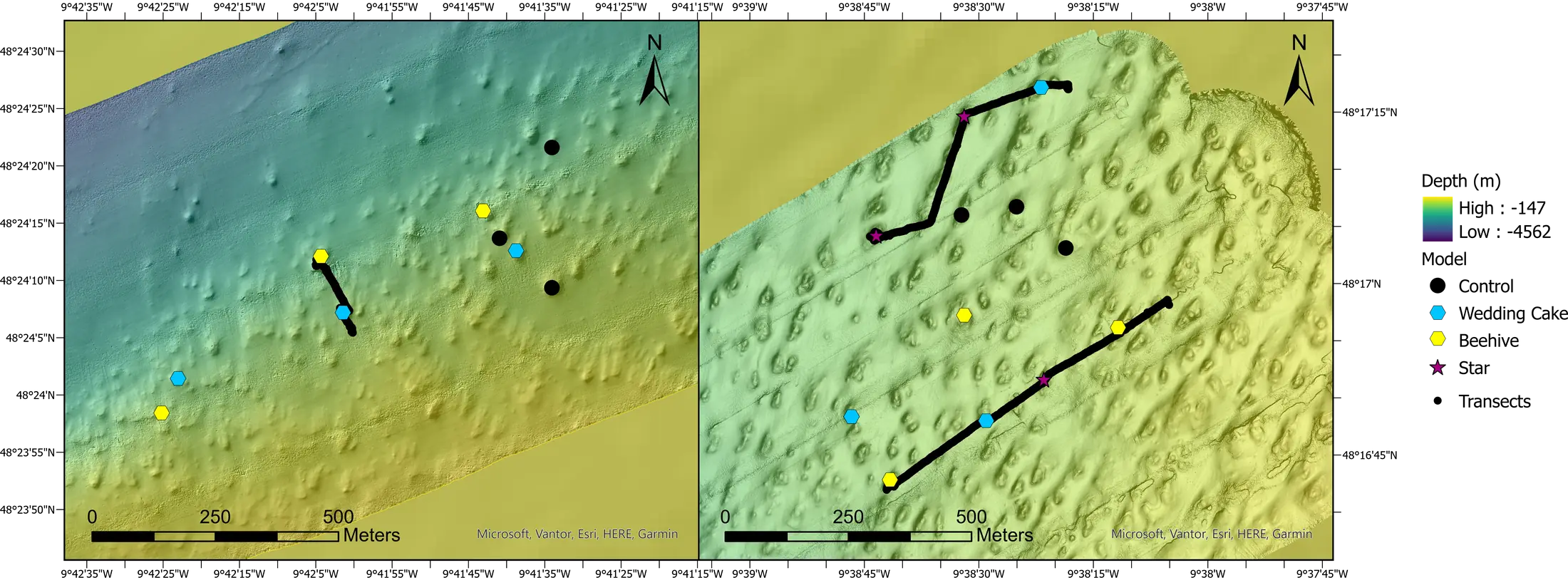
From 2–22 May 2026, RRS Discovery Expedition 210 was conducted to continue the multidecadal research programme at the Porcupine Abyssal Plain Sustained Observatory (PAP-SO) in the North Atlantic. Managed by the National Oceanography Centre (NOC) as part of the Natural Environment Research Council’s (NERC) AtlantiS National Capability programme, PAP-SO hosts the world’s longest-running time series of life on an abyssal plain, with observations spanning more than four decades since 1985. Along the way, there was the opportunity to revisit the eco-reefs that were deployed within The Canyons Marine Conservation Zone (MCZ) in September of 2025 as part of Project REDRESS on the DY200 research expedition. NOC scientists used the ROV HyBIS, a towed camera platform equipped with manoeuvring thrusters, to survey over the eco-reef sites at the Dangaard and Explorer interfluves (Fig. 2). Using the vessel’s dynamic positioning, the survey team navigated precise headings and distances to approach just short (~ 10m) of the deployment coordinates, before utilizing HyBIS’s onboard sonar to guide the final flyover. This approach resulted in the successful first visual monitoring of 9 out of a total 15 eco-reefs.
Fig. 2 Eco-reef deployment sites on the coral mini mounds at the Explorer (left) and Dangaard (right) interfluves of the Whittard Canyon System. Black lines represent the transects conducted on the current research cruise.
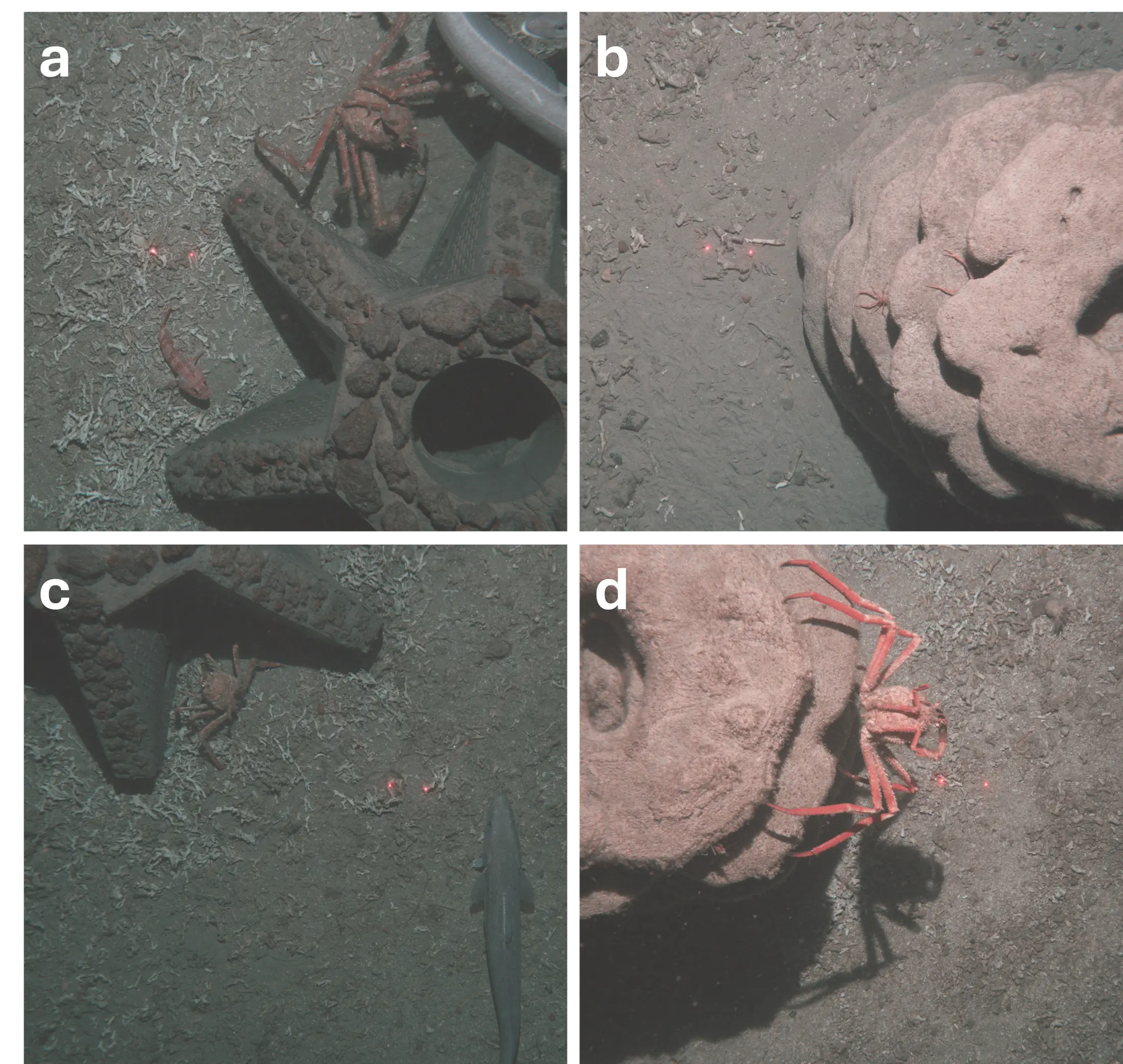
Initial imagery analysis confirmed that all eco-reefs remain structurally intact and securely positioned on the targeted coral mini mounds. While long-term larval recruitment of cold-water corals is a slow process in the deep sea, these early observations from eight months post-deployment revealed that the structures are already being interacted with in the local environment. Initial colonisation and visitation by several mobile benthic and demersal species were recorded (Fig. 3), demonstrating that the eco-reefs are already functioning as localized areas of interest in an otherwise flattened / degraded habitat. Furthermore, these visual surveys provide a valuable early data point ahead of planned dedicated ROV-based monitoring efforts scheduled for 2028 as part of Project REDRESS.
Fig. 3 Imagery of eco-reefs captured during ROV HYBIS dives 110 and 112 at the Whittard Canyon, Explorer and Dangaard Interfluves at 8 months post-deployment. Images show initial utilization of reefs by Helicolenus dactylopterus (a), Molva molva (a, c), Paromola cuvieri (a, c, d), squat lobsters (a, b) and shrimp (d).
Gestisci Consenso Cookie
Per fornire le migliori esperienze, utilizziamo tecnologie come i cookie per memorizzare e/o accedere alle informazioni del dispositivo. Il consenso a queste tecnologie ci permetterà di elaborare dati come il comportamento di navigazione o ID unici su questo sito. Non acconsentire o ritirare il consenso può influire negativamente su alcune caratteristiche e funzioni.
Funzionale
Always active
L'archiviazione tecnica o l'accesso sono strettamente necessari al fine legittimo di consentire l'uso di un servizio specifico esplicitamente richiesto dall'abbonato o dall'utente, o al solo scopo di effettuare la trasmissione di una comunicazione su una rete di comunicazione elettronica.
Preferenze
L'archiviazione tecnica o l'accesso sono necessari per lo scopo legittimo di memorizzare le preferenze che non sono richieste dall'abbonato o dall'utente.
Statistiche
L'archiviazione tecnica o l'accesso che viene utilizzato esclusivamente per scopi statistici.L'archiviazione tecnica o l'accesso che viene utilizzato esclusivamente per scopi statistici anonimi. Senza un mandato di comparizione, una conformità volontaria da parte del vostro Fornitore di Servizi Internet, o ulteriori registrazioni da parte di terzi, le informazioni memorizzate o recuperate per questo scopo da sole non possono di solito essere utilizzate per l'identificazione.
Marketing
L'archiviazione tecnica o l'accesso sono necessari per creare profili di utenti per inviare pubblicità, o per tracciare l'utente su un sito web o su diversi siti web per scopi di marketing simili.